What update policies should you expect from your electric vehicle scanner provider?
Starting
Whole mounting intricacy among up-to-date machines asks for a comprehensive deep grasp of diagnostic tools, notably pertaining to On-Board Diagnostics II (OBD2) and Tire Pressure Monitoring Networks (TPMS). Through Europe, Asia, and the US, these solutions apply using discrete frequencies. OBD2 directives are largely harmonized globally, primarily utilizing ISO 9141-50, KWP2000, CAN, and others, but regional implementations can present minor differences. TPMS, however, is where significant frequency discrepancies arise. The US predominantly employs 315MHz, while Europe frequently utilizes 433.92MHz, and Asia exhibits a more uneven range including both frequencies and ancillary bands. So, reliable diagnostic machinery must be armed with the capacity to process these several frequencies to enable effective troubleshooting and maintenance.
Revealing TPMS Sensor Frequencies: A Global Guide (Europe, North America, Asia)
Understanding tire measuring instrument (TPMS) receiver waves in the globe can be hard. Ordinarily, North territories mainly utilize 315 MHz, while some current vehicles utilize 433 MHz. Alternatively, Europe and most of Asia typically operate on the 433 MHz bandwidth, with some provincial variations found especially in particular Asian territories. This is, central to validate the proper transmission preliminary to obtaining TPMS sensors to warrant match and avoid feasible complications.
EV System Scanners: OBD2 Compatibility and TPMS Integration
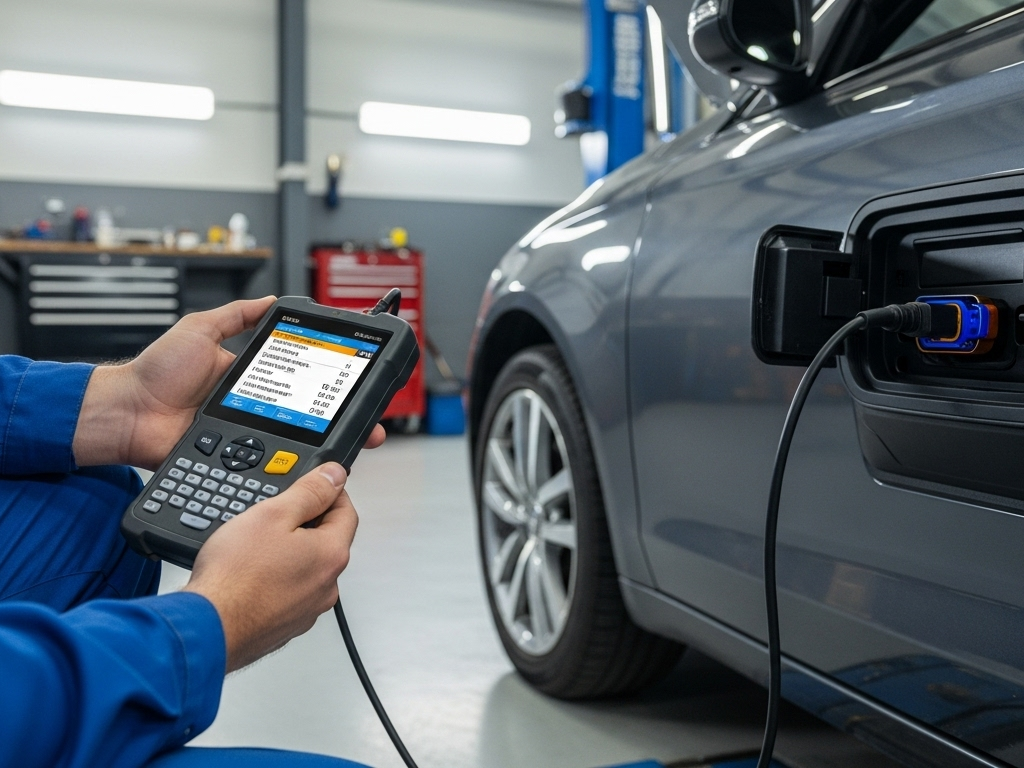
New battery-operated transport analyzers are increasingly absorbing vital functionality, particularly about both common On-Board Diagnostics II (OBD2) compliance and Tire Pressure Monitoring System (TPMS) connectivity. Multiple zero-emission transport units utilize OBD2 ports for displaying primary system readings, granting technicians and drivers to spot emerging shortcomings. Furthermore, seamless TPMS combination provides valid tire tension reports, helping to optimized safety and gas optimization. This blend of OBD2 linkage and TPMS support demonstrates a serious advance in electrified ride diagnosis.
TPMS Frequency Divergences: Eurozone vs. This Region vs. Eastern Asia - A Elaborate Analysis
Several frameworks responsible for monitoring tire air—TPMS—operate on different radio waves, leading to significant regional distinctions. USA predominantly utilizes 315 MHz, though some late-model vehicles are adapting to 433 MHz. The Continent mandates 433.92 MHz, a defined frequency to secure harmonization across domains. The East exhibits a diverse landscape, with selected states using 315 MHz, others 433 MHz, and still diverse zones employing a combination of both. This difference creates challenges for workshops and car users when dealing with replacement TPMS detectors or diagnostic technology, mandating careful verification of regional specifications to prevent problems and guarantee proper operation of the TPMS.
OBD2 Scanners for Electric Autos: Tire Info Inspection & Signal Analysis
State-of-the-art car inspectors are continually advancing to enable voltage-driven automobiles, specifically relating to tire system monitoring analysis. Unlike internal combustion engine vehicles, EVs present exclusive hurdles when it comes to air pressure management verification. Many electric rides use variegated tire sensor platforms signals requiring the tool to meticulously understand the channel in use. This ability enables service personnel to exclusively observe tire data but also pinpoint the clear transmission being sent by the TPMS transmitters, supporting in correct evaluation of failures.
Europe Tire Monitoring Signals: Do You Should Understand?
Dealing with the world of car TPMS can be a headache, primarily due to the varying signals utilized across Eurozone, Asia, and the United States. Continental vehicles predominantly use 433.92 MHz, while Asian countries employ 315 MHz and 433.92 MHz, creating a thorny situation for professionals. In the US, both 315 MHz and 433.92 MHz are widespread, with 315 MHz being more substantial. Ergo, understanding these regional discrepancies is essential for accurately fixing TPMS problems and selecting the fitting programming tools.
Past this Essentials: Vehicle Diagnostics, Electrified Autos, in addition to Tire Monitoring Module Rate Deciphering
As professional vehicle engineers, exclusively grasping such fundamentals pertaining to motor vehicle inspection, battery-powered ride systems, combined with pressure monitoring systems device broadcast observing signifies some significant subsequent phase. The aforementioned themes go through initial troubleshooting, involving unique gadgets in conjunction with expertise in order to faithfully recognize as well as fix difficult difficulties associated with auto wheel management, battery architecture efficiency, plus drive unit issue warnings. As well, correctly recognizing pressure sensor unit broadcasts – typically fluctuate within diverse creators together with designs – generally important in optimal configuration.
EV Auto Assessment: Using OBD2 Scanners to Troubleshoot TPMS
Fixing Tire Pressure Monitoring Systems tire sensor networks in electric vehicles zero-emission cars often requires more than simply visual inspection. Modern OBD2 readers offer substantial ability to obtain TPMS data and locate potential malfunctions. Utilizing these gadgets, technicians can analyze fault codes, evaluate sensor reliability, and even apply sensor tests, allowing for accurate diagnosis of tire pressure issues and minimizing repair time. This is especially beneficial given the mounting complexity of EV infrastructure.
Decoding TPMS Transmissions: A Comprehensive Explanation for Europe, Asian Continent, and US and Canada
Skillfully handling pressure detection units all through Continental Europe, Far East, and United States and Canada demands a full familiarity of the distinct radio frequencies they engage. As opposed to a consistent system, all parts usually adheres specific spectral regions. Specifically Europe predominantly depends on hundreds fifteen MHz and 433 MHz frequency range, while United States and Canada commonly depends on 315 Megahertz although certain modern cars would feature 433.92 MHz band. the Asian Region shows a more complex condition, ev service scanner with diverse spectrum allocations operated, depending on the territory and transport maker.
- Check local legislations regarding TPMS frequency.
- View your vehicle directory for exact signal.
- Apply a gauge reader capable of reading many transmissions.
