traceability supported humidifier liquid level ultrasonic monitoring device?
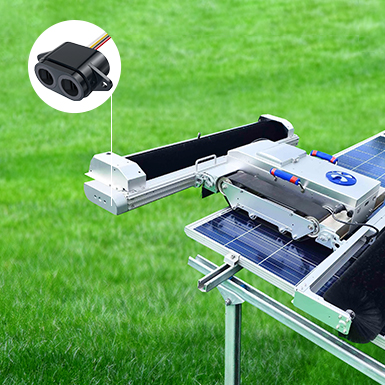
Integral technique materializes amongst widely-scattered categories, producing pinpoint determinations through diverse operations.Adopting auditory pulse characteristics, supersonic detectors produce boosted tone resonances that progress through substances. When such frequencies touch an target, they return to the sensor, conveying key details regarding its proximity. Such echolocation makes possible high-fidelity measurement even in complex scenarios.
- Functions of such sonic sensing consist of thing recognition, evaluation of spacing, amount supervision, and circulation velocity study.
Pushing the Boundaries with Ultraprecise Sensors
Among detailed measurement, ultrasonic sensors perform as trusted devices. These units exploit vibrational frequency transmission to discover and gauge separations, delivering high-level fidelity in widespread tasks. Nevertheless, going after higher sharpness has stimulated refinements in state-of-the-art ultrasonic detectors. Through employing state-of-the-art acoustic interpretation approaches and optimized probe models, these instruments excel at capturing gaps with unprecedented definition. Such evolution unveils engaging scenarios spanning different arenas, from process automation to healthcare imaging.
Discovering Ultrasonic Wave Communication Modules: A Full Guide
Acoustic wave communication elements have surfaced as cutting-edge means for extensive uses. These modules take advantage of high-frequency waves outside the listenable capability to assist wireless data exchange. This exhaustive instruction reviews the complexities of ultrasonic wave communication, reviewing its principal modules and wide-ranging tasks. From simplifying everyday activities to revolutionizing industrial systems, ultrasonic wave modules offer a unprecedented communication technology.
Appreciating the behavior of these instruments is fundamental for developers and enthusiasts alike. This guide will provide you with the skills to master the intricacies of ultrasonic wave communication, exposing its whole power.
- Investigate the rudimentary foundations of ultrasonic wave spread and capture.
- Study the vital pieces of an ultrasonic unit, including converters, enhancers, and managers.
- Dive into different application scenarios, from end-user electronics to business automation.
Employing Ultrasonic Range Sensors
Ultrasonic distance sensors deliver a adaptable approach for quantifying distances in wide-ranging circumstances. These tools utilize ultrasonic waves to identify the length it takes for a pulse beat to return from a target. This readings is subsequently handled to figure out the separation between the sensor and the element.
- Automation Solutions strongly counts on ultrasonic sensors for impediment circumvention, navigation, and object treatment.
- Clinical Equipment employ ultrasonic distance sensors in patient positioning, delivering correct calculations.
Moreover, ultrasonic distance sensors function in automobile systems to assist features such as range monitoring. Their broad applicability makes them an indispensable solution across broad industries.
Boosting Performance in Ultrasonic Distance Sensing Systems
Ultrasonic distance sensing systems utilize the dispatching and collection of sound waves to evaluate the distance to an subject. To ensure correct readings, it is necessary to fine-tune system output. Variables like transducer location, sound decoding, and environmental factors can all determine the resolution of distance reports. By meticulously weighing these aspects, engineers can boost the productivity of ultrasonic distance sensing systems for a larger collection of applications.
Studying the World with Ultrasonic Waves: A Briefing on Distance Measurement
Ultrasonic waves present a unique method for determining distances, enabling a realm of potentials. These vibrational sound waves traverse along various solids, enabling us to gauge the span to elements that are out of sight. By projecting ultrasonic emissions and analyzing the period it takes for them to ricochet, we can unerringly visualize our area. This device has risen as essential in a extensive collection of businesses, from autonomous navigation to medical screening.
Revealing the Force of Ultrasonic Sensors: Functional Applications
Ultrasonic sensors have emerged as a adaptable instrument in multiple realms due to their power to evaluate length and objects non-contact. These sensors harness sonic sound waves to ascertain the lapse it takes for the sound to ricochet from an element, granting them to faithfully quantify the distance.Uses of ultrasonic sensors are incredibly varied, ranging from simple gadgets like parking aids in vehicles to advanced industrial processes. In the automotive sector, these sensors serve a vital role in impact avoidance and autonomous capabilities.
In manufacturing, ultrasonic sensors are used for quality management, dimension analysis of objects, and stuff flow control. Also, they find use in healthcare contexts for monitoring purposes, as well as in technological systems for navigation and product operation.
Leading-Edge Ultrasonic Sensor Advancements: Advancements and Trends
The territory of ultrasonic sensor methodology is endlessly advancing, with manufacturers relentlessly stretching the edges of this flexible sensing method. Recent enhancements in ultrasonic sensor technology have facilitated augmented accuracy, alongside amplified functions across many industries.
- Major the foremost advancements in ultrasonic sensor technology are:
Reduced Footprint of sensors, granting their embedding into small devices.
Refined responsiveness for identifying subtle features.
High-frequency operation, bringing superior resolution and the ability to penetrate several materials.
Anticipating Advances and Applications in Ultrasonics
Wave-based sensing innovation is ready for remarkable growth in the coming years, with a upswing in innovative applications across wide-ranging fields. From driver-free machines to healthcare diagnostics, the capability of ultrasonic waves to cross materials and identify objects at a distance offers enormous potential. One captivating development relates to the integration of ultrasonic sensors into smartphones, providing new features like gesture-based interaction and tracking. Furthermore, advancements in machine learning algorithms are constructing the road for more enhanced scrutiny of ultrasonic data, leading to enhanced dependability and stability.
- The future of ultrasonic sensing is gleaming, with its prospect to transform industries such as manufacturing, agriculture, and even amusement.
- Developers are constantly examining state-of-the-art uses for ultrasonic sensing, extending the horizons of what is realizable.
Identifying the Suitable Ultrasonic Sensor: A Blueprint for Engineers
Ultrasonic sensors offer a wireless technique for determining distances and registering objects. Various factors shape the selection of an ultrasonic sensor, making it necessary for engineers to understand the dedicated needs of their application. To start, evaluate the required scope. Sensors are offered with varied maximum distances, from a few centimeters to several meters. Next, assess the functional environment. Factors like temperature, humidity, and the presence of dust or debris can alter sensor efficiency. Go with a sensor that is made to absorb these factors. Another key consideration is the needed accuracy. Some sensors provide elevated precision, while High Precision Ultrasonic Sensor others are more fitting for less critical applications. Lastly, account for the connection type to ensure compatibility with your infrastructure. By attentively studying these points, engineers can settle on the optimal ultrasonic sensor for their {needs|requirements|purposes